🦵 Not sure what's causing it? Take the 5-question knee quiz.
Find My Pattern →Knee Pain From Bad Posture
You've made it through most of the workday sitting relatively upright, shoulders back, core engaged—doing everything right. Then around 3 p.m., you relax into your chair just slightly, and within minutes there's a dull, heavy sensation building behind your kneecap. By the time you stand up to leave, there's a sharp twinge as your knee protests the transition. The pain isn't there when you're moving around, but it returns the moment you sit back down. This delayed response—where the ache emerges not during bad posture, but after you've tried to correct it—is one of the most confusing aspects of posture-related knee pain, and it's rarely talked about directly.
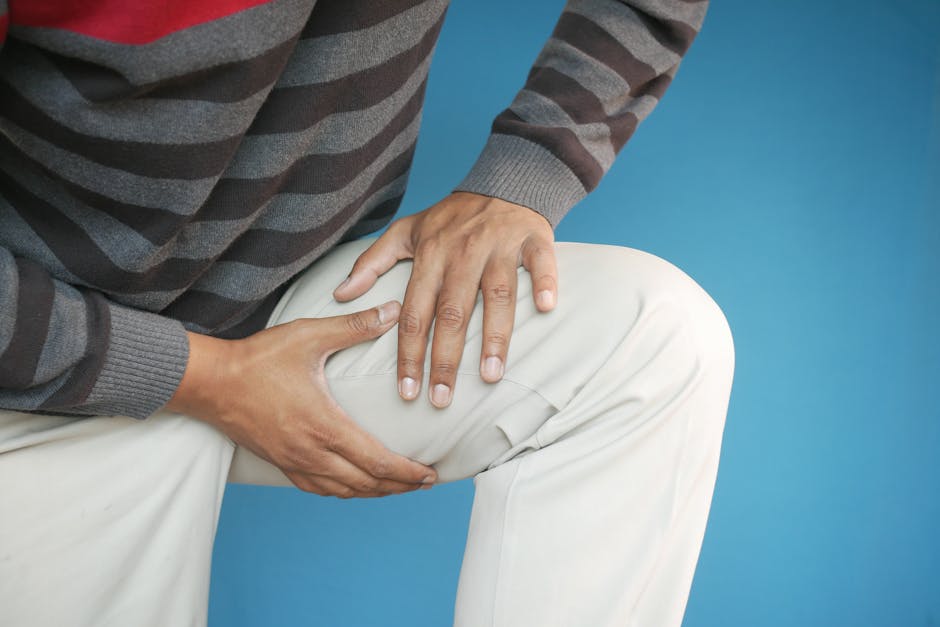
Why posture affects your knees more than you'd expect
🦵 Not sure what's causing your knee pain?
Answer 5 quick questions and get a personalised result.
Find My Pattern → 60 seconds · No sign-upBad posture doesn't hurt your knees directly. Instead, it creates a chain reaction through your hips, thighs, and lower back that eventually loads your knee joint in ways it wasn't designed to handle.
When you slouch or let your pelvis tilt backward as you sit, your hip flexors tighten and your glutes become less active. This changes how your thighbone sits in relation to your shinbone. Your quadriceps—the muscle group on the front of your thigh—has to work harder to stabilize the knee, but because of the postural position, it's working at a mechanical disadvantage. Over hours of sitting, this creates fatigue in the muscle, and fatigued muscles can't protect your joint effectively. The result can be a dull, tired sensation that feels like it's coming from inside the knee itself. This is also the mechanism behind knee pain from hip weakness — the posture keeps the glutes from activating the way they need to.
Stress and tension also play a role that most posture articles skip entirely. When you're anxious or concentrating hard, your shoulders creep toward your ears, your chest caves slightly inward, and your whole spine rounds forward. This postural collapse happens unconsciously, and it often triggers a cascade of muscle tension down through your hips. Tight hip muscles pull on the structures around your knee, creating that heavy or achy feeling.
There's also a muscle-memory problem. Your body has spent months or years in a certain posture, and your nervous system considers that position "normal" and efficient—even if it's damaging. When you try to correct it, your muscles are working against their established patterns. This effort itself can trigger soreness or discomfort, sometimes hours after you've relaxed back into your old habits. That's why you might feel worse the morning after a day of "perfect" posture attempts.
What you can try—carefully and gradually
Start with awareness of your collapse points. Rather than aiming for perfect posture all day (which is exhausting and often unsustainable), notice when your posture breaks down. Is it after meetings? When you're focused on a task? Late afternoon when fatigue sets in? Once you recognize the pattern, you can interrupt it before the muscle fatigue accumulates. A gentle shift in position every 20 minutes—not a dramatic correction, just a small adjustment—can prevent the buildup that leads to evening knee pain.
Change how you sit, not just how straight you sit. The position matters less than the variety. If you sit the same way for six hours, your tissues adapt to that single position and become stiff. Try alternating between a more upright position, a slightly reclined position, and even a crossed-leg position (if that's comfortable for you). Movement between positions is what prevents the localized fatigue that triggers knee pain.
Pay attention to your hip position before your back. Your pelvis is the foundation for everything above it. If your pelvis is tucked under (posterior tilt), your whole spine compensates. Try sitting with your sitting bones clearly contacting the chair, which naturally tilts your pelvis forward slightly. This small change often reduces the tension that travels down to your knees, even if your upper back isn't perfectly straight.
Notice the difference between muscle soreness and joint pain. Posture-related knee pain is usually a dull, muscular ache rather than a sharp, localized pain. If you're feeling sharp twinges or pain that doesn't ease with position changes, that may signal something different. Muscle soreness from postural correction often feels tender to touch on the thigh or around the knee, whereas joint pain feels more internal and doesn't respond to rubbing.
Build tolerance gradually if you're correcting long-standing posture. If you've slouched for years, your muscles aren't conditioned for better alignment. Trying to maintain "perfect" posture for eight hours will exhaust those muscles and can trigger soreness. Instead, aim for 10 minutes of conscious posture correction, then relax. Gradually extend the duration as your muscles adapt. This prevents the overuse soreness that makes people abandon posture correction entirely.
When to reach out to a professional
If your knee pain is sharp, persistent despite position changes, or accompanied by swelling or instability, posture alone isn't the full picture. A physical therapist can assess whether muscle imbalances, hip tightness, or alignment issues are contributing. They can also rule out structural problems that posture correction won't address.
Safety note: If you have severe pain, significant swelling, a recent injury, fever, numbness, or difficulty bearing weight, speak with a qualified healthcare professional promptly.
Frequently Asked Questions
Q: Can I still walk normally when I have knee pain from bad posture?
A: Many people manage normal walking despite this kind of discomfort. If walking causes you to limp or noticeably change your gait, though, that's worth addressing — compensating patterns often create new problems in the hips, lower back, or opposite knee over time.
Q: Is it normal to hear clicking sounds alongside knee pain from bad posture?
A: Joint sounds are extremely common and usually harmless — they often come from gas bubbles in the joint fluid or tendons flicking over bony prominences. If the clicking is painless and your knee functions normally, it's generally nothing to worry about. If it's accompanied by pain or swelling, mention it to a healthcare professional.
Q: Should I use a knee brace or compression sleeve for knee pain from bad posture?
A: A basic compression sleeve can offer comfort and mild support during activity, and many people find it helpful in the short term. Don't rely on it long-term without also addressing the root cause — whether that's strength, flexibility, or movement patterns.
A Simple Next Step
Most people who take early, sensible action recover well. Start with what you can manage today and monitor closely. If things are not improving after a few weeks, that is the right time to bring in professional support.
Helpful Next Step
As an Amazon Associate, we may earn from qualifying purchases. This does not affect the price you pay.
Helpful Support Option
If this type of knee discomfort shows up during daily movement, light support may help reduce strain on the joint while you work on the underlying cause.
See knee support options on AmazonHelpful Next Step
If gentle support helps during recovery, you can check a simple support option that many people use in daily life.
This content is for educational purposes only and does not constitute medical advice. Always consult a qualified healthcare professional for diagnosis and treatment.