🦵 Not sure what's causing it? Take the 5-question knee quiz.
Find My Pattern →Sharp Inner Knee Pain After Climbing Stairs
Stairs feel fine on the way up. It's the descent that catches you — that moment when you lower your weight onto the step below and feel a sharp, localized sting on the inner side of your knee. It might happen on every step, or only certain ones. Maybe it's worse on narrow stairs at home but manageable at work. The pain can disappear completely once you reach the bottom, leaving you wondering if it was real. Or it lingers into the evening, a dull throb that makes you favor that leg without thinking about it.
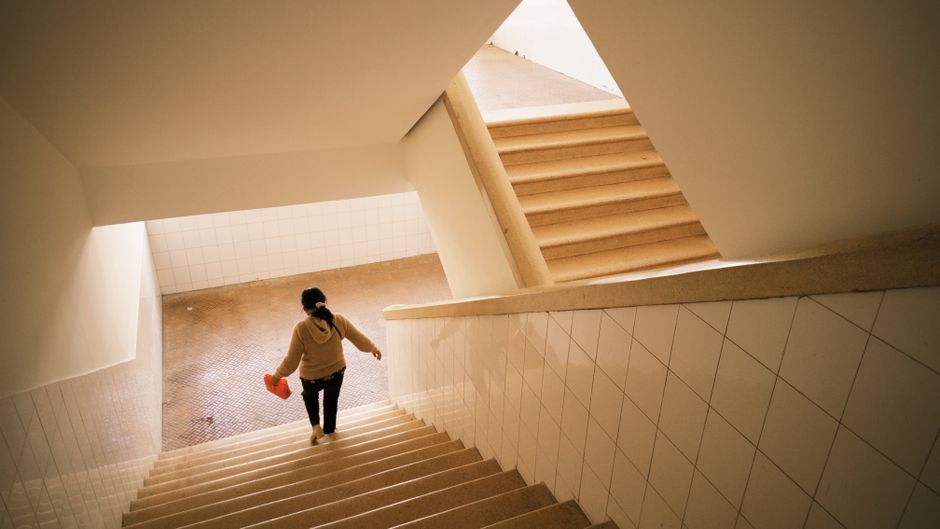
This specific timing — pain during the lowering phase rather than the climbing phase — tells you something important about what's happening inside your knee. Understanding that difference changes how you approach the problem.
Why the inner knee hurts during stair descent
🦵 Not sure what's causing your knee pain?
Answer 5 quick questions and get a personalised result.
Find My Pattern → 60 seconds · No sign-upWhen you lower yourself down a step, your knee bends while supporting your full body weight. This is called an eccentric load, and it places intense pressure on the structures on the inner side of your knee. Several things can trigger sharp pain in this exact scenario. This pattern is related to knee aches after climbing several flights of stairs, and the same management principles often apply.
Your medial collateral ligament (MCL) and the cartilage surfaces on the inner knee joint can become irritated from repetitive stress or a previous minor injury you may have forgotten about. The pain often feels like a sharp pinch rather than a dull ache, and it tends to appear at a specific knee angle — sometimes only when your knee bends to 60 degrees, sometimes at 45 degrees. That specificity is a clue that a particular structure is being compressed or stressed.
Weakness in your hip muscles, particularly the gluteus medius, can also cause this. When these muscles aren't strong enough, your knee caves inward slightly as you descend stairs. That inward collapse stresses the inner knee structures. You might notice this happens more when you're tired — your form breaks down, and the pain appears.
Tight calf muscles or restricted ankle mobility can force your knee to work harder during descent. If your ankle doesn't move freely, your knee compensates by bending more sharply, which can aggravate the inner structures. This is easy to miss because the tightness feels like it's in your lower leg, not your knee.
Sometimes the cartilage under your kneecap doesn't track smoothly in its groove, especially during the loading phase of stairs. This can refer pain to the inner knee even though the primary issue is elsewhere.
Practical approaches worth trying
Start by changing how you descend stairs. Instead of stepping down one stair at a time with alternating legs (the normal pattern), try stepping down with your affected leg first, then bringing your other leg to meet it on the same step. This reduces the range of motion your knee travels through and can significantly reduce sharp pain. It feels awkward at first, but many people find it works immediately.
Hold the railing with genuine weight on it. This isn't about balance — it's about load reduction. Gripping the railing and pulling slightly as you descend can reduce the force traveling through your knee by 10–15%. You'll feel the difference on the first step down.
Apply ice for 15 minutes after you've climbed stairs, especially if the pain lingers into the evening. Cold reduces inflammation and can dull the ache that builds throughout the day. Cold also helps if you notice that catching or grinding sensation that appears after sitting for 30 minutes, then worsens when you stand and move. There's a close connection between this and knee buckles when climbing stairs — the same structures are usually involved.
Strengthen your hip abductors in the weeks ahead. Lie on your side and lift your top leg slowly, holding for 2 seconds at the top. Do this for 10–15 repetitions, three times a week on each side. This addresses the inward collapse that stresses your inner knee. You won't feel relief immediately, but after 2–3 weeks of consistent work, you'll notice stairs feel different.
Stretch your calf gently. Stand facing a wall, step one leg back, keep your heel down, and lean forward slightly until you feel a stretch in your calf. Hold for 30 seconds, repeat three times per side. Do this daily. Improved ankle mobility reduces the compensatory stress on your knee.
Avoid taking stairs quickly or two at a time. Speed reduces your control and increases impact. Slow, deliberate steps give your muscles time to stabilize your knee properly.
When to contact a healthcare professional
If sharp pain persists beyond two weeks despite trying these approaches, or if the pain worsens, schedule an appointment. The same applies if you notice swelling on the inner knee, a sensation of instability (like your knee might give way), or if the pain begins affecting how you walk on flat ground.
Pay attention to any catching sensation that doesn't resolve, or pain that appears suddenly after a specific incident — a misstep, a fall, or a twist. These can indicate cartilage involvement that benefits from professional assessment.
Safety note: If you have severe pain, significant swelling, a recent injury, fever, numbness, or difficulty bearing weight, speak with a qualified healthcare professional promptly.
Frequently Asked Questions
Q: Should I apply heat or ice to a painful knee?
A: Cold — ice wrapped in a cloth — works better for acute flare-ups, particularly in the first 24 to 48 hours when the area feels warm or inflamed. Gentle heat tends to be more helpful for muscle stiffness and chronic, recurring aches. Never apply either directly to bare skin.
Q: Is it safe to exercise with sharp inner knee pain after climbing stairs?
A: Gentle, low-impact movement is often beneficial — walking, swimming, and cycling tend to be well-tolerated. Avoid anything that sharply increases the discomfort. A physiotherapist can help identify which exercises are right for your specific situation and severity.
Q: Can stretching help with sharp inner knee pain after climbing stairs?
A: Gentle stretching of the quadriceps, hamstrings, calves, and hip flexors can reduce the muscular tension that contributes to knee discomfort. A sustained, comfortable hold of 20 to 30 seconds is far more effective and safer than aggressive or bouncing stretches.
A Simple Next Step
Most people who take early, sensible action recover well. Start with what you can manage today and monitor closely. If things are not improving after a few weeks, that is the right time to bring in professional support.
Helpful Next Step
As an Amazon Associate, we may earn from qualifying purchases. This does not affect the price you pay.
Helpful Support Option
If this type of knee discomfort flares up on stairs, light compression or a supportive brace can help reduce strain on the joint while you work on strengthening the surrounding muscles.
See knee support options on AmazonHelpful Next Step
If gentle support helps during recovery, you can check a simple support option that many people use in daily life. For useful context, knee pain when climbing stairs tends to have the same mechanical roots and overlapping solutions.
This content is for educational purposes only and does not constitute medical advice. Always consult a qualified healthcare professional for diagnosis and treatment.