🦵 Not sure what's causing it? Take the 5-question knee quiz.
Find My Pattern →Morning Knee Stiffness After Climbing Stairs
That first step down from your bed feels heavy. Your knee doesn't bend quite right—there's a grinding sensation, maybe a slight catch that makes you pause before committing your full weight. You shuffle down the hallway, and by the time you reach the stairs, the stiffness is still there, thick and reluctant. But then something shifts. Halfway down the first flight, movement starts to feel easier. The pain transforms from sharp to dull. And for the next 10 or 15 minutes, you almost forget it was ever a problem. Then you sit at your desk, and within an hour, that heavy sensation creeps back in.
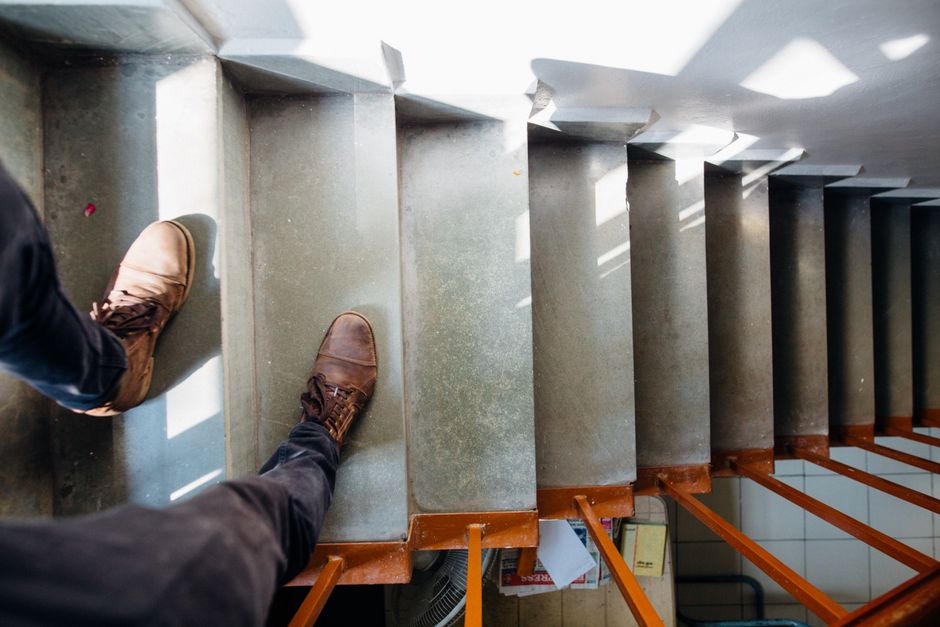
This pattern—stiffness that peaks not immediately upon waking but 30 to 60 minutes later, improves with movement, then returns after sitting—is specific enough that it deserves a real explanation.
Why your knees stiffen after stair use
🦵 Not sure what's causing your knee pain?
Answer 5 quick questions and get a personalised result.
Find My Pattern → 60 seconds · No sign-upWhen you climb or descend stairs, your knees work harder than they do during most daily activities. Each step requires your quadriceps (the muscle on the front of your thigh) to control how your knee bends and straightens, especially on the way down. This eccentric loading—where muscles lengthen while contracting—can create micro-damage in muscle fibers and surrounding tissues, even when you feel fine in the moment. This pattern is related to dull ache behind knee after climbing stairs, and the same management principles often apply.
Overnight, your body initiates a repair response. Fluid accumulates around the joint, and the tissues tighten slightly as part of this process. This isn't inflammation in the acute, swollen sense that follows an injury. Instead, it's a protective stiffening that often feels worst after you've been still for several hours. The moment you start moving, synovial fluid (the lubricant inside your knee joint) begins to circulate, and the muscles warm up. That's why the first few minutes of movement feel so much better.
The pattern can also reflect how unevenly you use your legs on stairs. If you favor one side—pushing off with your dominant leg more forcefully, or relying on the railing to pull yourself up—one knee may accumulate more fatigue than the other. You might notice the stiffness is worse on one side, or that one knee recovers faster than the other.
Age and previous injury history matter here too. If you're over 40, or if you've had a past knee injury, the tissues around your knee may not recover as quickly from the demands of stair use. This doesn't mean something is wrong; it means the timeline for stiffness to settle is longer. For useful context, front knee pain after climbing stairs tends to have the same mechanical roots and overlapping solutions.
What you can try
Move before you push. The instinct to stretch a stiff knee first thing in the morning can backfire. Instead, spend 5 to 10 minutes doing gentle, easy movement—walking slowly around your home, marching in place, or easy cycling if you have a stationary bike. This circulates synovial fluid and warms the muscles without forcing a tight joint through a large range of motion. Only after this warm-up does stretching become useful.
Manage stairs differently the day after heavy use. If you've done a lot of stair climbing—multiple flights, or climbing them repeatedly—your knees will likely be stiffer the next morning. On those mornings, take stairs one at a time rather than two, and use the railing. This reduces the load on each step and gives your muscles less eccentric work to manage. You're not avoiding stairs; you're modifying how you use them.
Apply heat before movement, ice after activity. A warm shower or heating pad for 10 to 15 minutes before you get moving can ease the initial stiffness by relaxing tight muscles. After you've climbed stairs or done activities that stress your knees, ice for 15 minutes can help limit any swelling that might contribute to next-morning stiffness. The timing matters: heat prepares; ice prevents.
Strengthen the muscles around your knee gradually. Weak quadriceps and hip muscles force your knee joint to work harder during stair use. Simple exercises like wall sits, step-ups on a low step, or straight-leg raises (lying on your back, lifting one leg straight) can build strength without the impact of stairs themselves. Start with just 2 to 3 sets of 8 to 10 repetitions, a few times a week. Progress slowly; more is not better.
Pay attention to recovery time between stair-heavy days. If you climb many flights on Monday and again on Tuesday, your knees won't have fully recovered. Spacing out stair-intensive activities by a day or two allows tissues to repair more completely, which can reduce next-morning stiffness.
When to speak with a healthcare professional
Morning stiffness that improves with movement is common and often manageable. But certain signs warrant professional evaluation. If the stiffness doesn't improve after 20 to 30 minutes of movement, if it's getting progressively worse despite these strategies, or if you're starting to avoid stairs in social or work settings because you're worried about pain, a physical therapist or doctor can assess what's happening and suggest a more targeted plan.
Safety note: If you have severe pain, significant swelling, a recent injury, fever, numbness, or difficulty bearing weight, speak with a qualified healthcare professional promptly.
Frequently Asked Questions
Q: How long does morning knee stiffness after climbing stairs usually last?
A: This varies a lot depending on the cause. Minor muscle strain or overuse tends to settle within a few days to two weeks with appropriate rest and gentle movement. If it hasn't improved after three weeks — or symptoms are worsening — that's a clear signal to get a professional opinion.
Q: When should I stop exercising because of morning knee stiffness after climbing stairs?
A: Stop if the pain is sharp, climbing steadily during exercise, or causing you to change how you move. Mild, stable discomfort that stays at a 2 to 3 out of 10 is often acceptable to work through gently. Anything above that — or pain that simply feels wrong — is your cue to stop and reassess.
Q: Is it normal to hear clicking sounds alongside morning knee stiffness after climbing stairs?
A: Joint sounds are extremely common and usually harmless — they often come from gas bubbles in the joint fluid or tendons flicking over bony prominences. If the clicking is painless and your knee functions normally, it's generally nothing to worry about. If it's accompanied by pain or swelling, mention it to a healthcare professional.
One Thing to Try First
Most people who take early, sensible action recover well. Start with what you can manage today and monitor closely. If things are not improving after a few weeks, that is the right time to bring in professional support.
Helpful Next Step
As an Amazon Associate, we may earn from qualifying purchases. This does not affect the price you pay.
Helpful Support Option
If this type of knee discomfort flares up on stairs, light compression or a supportive brace can help reduce strain on the joint while you work on strengthening the surrounding muscles.
See knee support options on AmazonHelpful Next Step
If gentle support helps during recovery, you can check a simple support option that many people use in daily life. There's a close connection between this and knee aches after climbing several flights of stairs — the same structures are usually involved.
This content is for educational purposes only and does not constitute medical advice. Always consult a qualified healthcare professional for diagnosis and treatment.